


Bieke van Nes: Overcoming Barriers & Borders
Playing hockey in Canada was always the end goal, the ultimate destination. Growing up in the Netherlands, hockey was a little too small to dream big within our own borders. We were good at field hockey and speed skating, but the combination unfortunately never took off.
Like most girls who start at a young age, I grew up playing boys’ hockey. At 6 years old, I finally convinced my parents to let me play, after spending weekends watching my brother’s games and Wednesday afternoons playing shinny on the open ice at the local rink. It didn’t bother me that I had to play with boys. My best friends were on the team and my brother and I really grew up together playing.
But I remember the first time I was confronted with a ceiling that I knew my brother wouldn’t have to deal with. I was 12 years old when I got invited to try out for the U14 national development program. My dad came with me, a two hour car ride, but when I tried to sign in, they turned me away. They hadn’t realized I was a girl, and the try out was for boys only. Because they felt bad, they allowed me to go on the ice, but made it very clear that I would not make it into the program. To say I was disappointed was an understatement.
You see, we didn’t have a girls program like that. We didn’t even have a competitive girls league for us to play in at any age. In fact, we barely had any girls playing hockey. In the Netherlands, there’s a total of around 200 girls playing hockey. That’s less than 0.001% of the country’s population. To put it into perspective, that would mean that only 400 girls of all ages would play hockey in Canada. Imagine that. I was 13 when I was recruited for the national women’s team. Not because I was so crazy talented, because I was not. The oldest woman on the team at that time was 41. The pool of appropriate-aged and decent-level girls was just that small. For the World Championships in 2011, we didn’t even have enough players to be allowed to join, so we registered extra goalies and assistant coaches as players. That’s how scarce it was. It’s incredible to think how far we’ve come since then.

I made a short trip abroad, two years, but after visa technicalities I had to go back. So there I was, 21 years old, and still playing boys’ hockey. Although I guess it would be considered men’s hockey at this point. The majority of my national team teammates played in the men’s division 1, the highest women were allowed to play. It was a full-contact league, we were up against guys that had 8 years, 7 inches and 50 pounds on us, and it started to cause problems for some girls. Girls were getting injured playing against these men, and if you think they held back against us, you are wrong. The only thing more embarrassing than bodychecking a girl is getting beat by a girl, so more often than not they went for option 1. Some girls had to sit out a while with concussions, others just quit altogether. I wanted to avoid either option, so I started looking abroad again.
Canada was my number one option, because I had a great experience playing there before, and it was semi-affordable for a foreigner to go to school there. But reaching the necessary people to even get heard as a small-time hockey player from the Netherlands was a lot harder than expected. Most people never answered me. Others replied at first but then lost interest. There are so many talented hockey players so much closer to home, so why would they bother looking elsewhere? It took me three tries to eventually get an answer from my current school. And not because they were uninterested the first two times, but because it’s so easy to slip through the cracks. But I knew what I wanted, so I persisted and was eager to play at this level of women’s hockey.
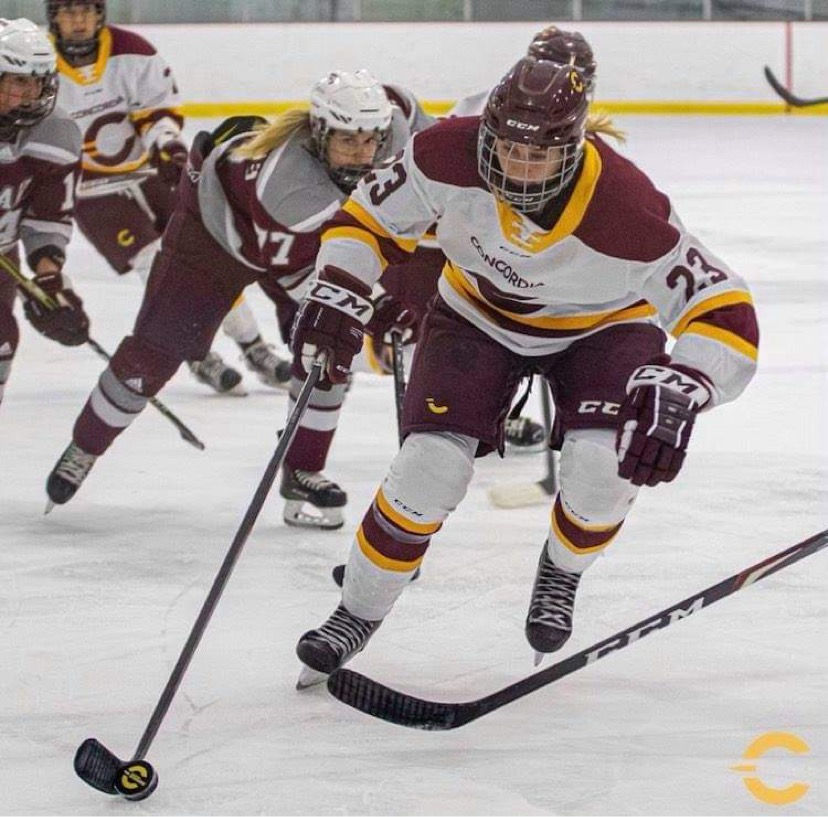
Concordia was recommended to me by various people; coaches, teammates and friends who knew the program and who’d had great experiences with the school, so my decision was an easy one. Actually joining the RSEQ was a different challenge. When the critics of women’s hockey say it’s not the same as men’s hockey, they are right. It’s a completely different game, which is what makes it so interesting. But coming from playing men’s hockey, I was not ready for the game to be so much more strategic. The tactical aspects were so much more important, and the physical game that I had learned to play no longer had an effect. I wasn’t trying to skate around checks anymore, I was trying to outsmart the other team’s strategy, which was completely new territory for me. So much thought goes into every little detail of the game. But the coaching in this league is one of a kind, and I know that it’ll be a challenge to ever play for a team with a coaching staff as stacked as this one. They taught me so many things over the last couple of years, and I’m excited to implement them on an international level.
"The future of women’s hockey is looking bright. Our national team is climbing into the top 16 internationally, women’s hockey in North America is gaining exposure, and I’m excited to be part of this movement..."
Playing further away goes hand in hand with certain challenges. Missing family is always hard, but playing for the national team at a young age and travelling all over the world has taught me how to be away from home and still be close with my family. The biggest challenge for me in coming here was adjusting to the level of the RSEQ and my specific role on the team. A league of this level attracts the best players from CEGEP and junior teams, and yet there need to be third and fourth liners, even here. It is a role that I think most players in the league are unfamiliar with before coming here. I certainly was. But playing with teammates that were better than me has caused me to push myself even harder, and made me learn faster than I have ever experienced.
Now my time here in the RSEQ is coming to an end, a different end than anyone could’ve foreseen of course, and I am so grateful that I was able to spend the past three years here. I have learned so much about hockey, and about myself. I’ve been pushed, knocked down, helped back up, and developed in so many different ways, probably even more than I currently realize. Now I’m getting ready for my next adventure, playing professionally, something that my 6-year-old self could’ve only dreamt of. It’s crazy to think how different it would’ve been if they hadn’t taken a chance on some nobody from a small rainy country that is known for its soccer players. But I guess everything happens for a reason.
The future of women’s hockey is looking bright. Our national team is climbing into the top 16 internationally, women’s hockey in North America is gaining exposure, and I’m excited to be part of this movement that will hopefully help the next generation believe that they can accomplish their dreams, because they’ve seen that it is possible.
Comments